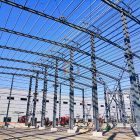
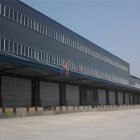
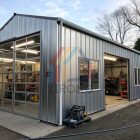
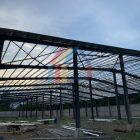
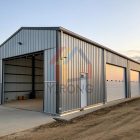
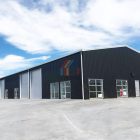
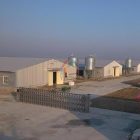
Steel frame storage buildings are the cornerstone of industrial warehousing
With the global e-commerce penetration rate exceeding 20%, the demand for industrial warehousing is showing exponential growth. The shortcomings of traditional concrete buildings in terms of cost, construction period, and environmental friendliness are gradually being replaced by the innovative advantages of steel frame storage buildings. Manufacturing giants represented by China, the United States, and Germany have applied this technology to scenarios such as cold chain logistics and automated three-dimensional warehouses, driving the global warehousing industry to transform towards efficiency and low-carbon.
What is a steel frame storage building?
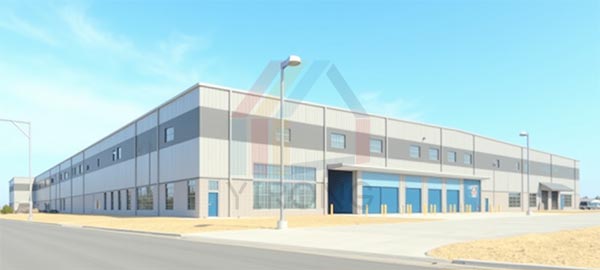
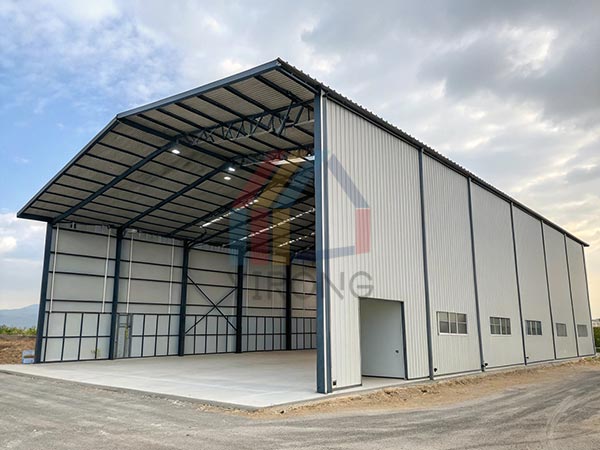
Steel frame storage buildings are mainly composed of steel frame structures, combined with prefabricated assembly design, forming large-span and high clearance storage spaces, suitable for industrial product storage, cold chain logistics, and automation equipment deployment.
Global application cases
Amazon Kiva Robot Warehouse in the United States: Using a steel frame structure to achieve a column free space with a height of 12 meters and a span of 30 meters, suitable for AGV unmanned warehouse layout.
China’s “Asia No.1” Intelligent Logistics Park: Steel structure buildings shorten construction period by 50%, with a seismic rating of 8, meeting the needs of areas with multiple seismic zones.
Rotterdam Cold Chain Warehouse in the Netherlands: A combination of sandwich panel insulation and steel frame achieves a green storage benchmark with a 40% reduction in energy consumption.
According to the Global Market Insights report, the global modular warehousing market will exceed $45 billion in 2023, with steel frame structures accounting for 62%. It is expected to exceed $120 billion by 2030.
The three core advantages of steel frame structure
1. Cost effectiveness: Save 30% investment compared to traditional buildings
Material cost: The steel recycling rate exceeds 90%, and factory prefabrication reduces on-site construction waste.
Construction period advantage: The on-site installation of modular components only requires one-third of the traditional construction period, and the capital turnover rate is significantly improved.
Maintenance cost: The weather resistant steel coating technology extends the building’s lifespan to over 50 years and reduces maintenance frequency by 60%.
2. Adaptability: A universal solution to meet extreme demands
Breakthrough in span: Single span can reach 60 meters, column free space suitable for automated warehousing equipment.
Rapid transformation: bolted connection nodes facilitate later functional zoning adjustments, meeting the ever-changing warehousing needs of e-commerce.
Climate compatibility: From Arctic permafrost storage (-50 ℃) to Middle Eastern desert storage (+50 ℃), the thermal expansion coefficient of steel structures is controllable.
3. Sustainability: an inevitable choice in the era of carbon neutrality
Low carbon production: Green hydrogen steelmaking technology in the steel industry can reduce carbon emissions by 70%.
Energy integration: The integrated design of rooftop photovoltaic and steel frame load-bearing makes the storage building a micro power station.
Circular economy: Demolished steel can be directly used for new projects, in compliance with the EU EPD Environmental Product Declaration standards.
Differentiated application scenarios in the global market
1. Developed countries
The “Super Hub” Plan in the United States: Giant logistics centers supported by steel frame structures (such as the Amazon hub in Nevada) have a single warehouse processing capacity of over 1 million pieces per day.
Urban Warehousing in Japan: Steel structure multi-level three-dimensional warehouses (such as Tokyo Hiratsuka Warehouse) solve the problem of land scarcity and increase the plot ratio by three times.
2. Emerging markets
Southeast Asian e-commerce outbreak: Indonesia and Vietnam adopt light steel factory buildings and detachable designs to adapt to tropical cyclone climates.
Construction of African Industrial Belt: The steel storage project in Nigeria’s Lekki Free Trade Zone has shortened the construction period to 8 months through a modular approach.
Future Trends
Intelligent construction: 3D printing steel structure node technology will further improve on-site installation efficiency by 40%.
Digital twin: BIM models are linked with the Internet of Things to achieve real-time monitoring and safety warning of warehouse loads.
Material Revolution: The application of carbon fiber reinforced steel components may promote the popularization of super high-rise storage buildings (>50 meters).
Steel frame storage buildings reshape global supply chain
From smart port warehouses in Rotterdam to unmanned free trade zones in Dubai, steel frame structures are reconstructing the underlying logic of the warehousing industry with industrial thinking. For investors, choosing steel structures means lower Total Cost of Ownership (TCO) and higher ESG ratings. For designers, modular design opens up space for functional innovation. For all of humanity, this green construction method is providing key support for the goal of carbon neutrality.
Explore the possibilities of steel frame storage buildings and get in touch with the world’s leading steel structure engineering solutions provider to get a customized feasibility plan!