The entire manufacturing process of high-quality steel structures
In Manila, Philippines, two steel-structured office buildings exceeding 200 meters in height are rising, poised to become new local landmarks. In Saudi Arabia, the steel roof of the Lusail Stadium has withstood extreme weather conditions. Behind the creation of these high-quality steel structure buildings lies a precise manufacturing system encompassing design, processing, and testing.
With the 2025 “Work Plan for Stabilizing Growth in the Steel Industry” listing the promotion of steel structure applications as a core measure, and the “dual-carbon” goals driving green building upgrades, understanding the entire manufacturing process has become a core need for global construction professionals.
I. Digital Design and Material Selection
The foundation of high-quality steel structures begins with precise design and reliable raw materials, this stage directly determines the safety and durability of the building.
1.1. Digital Detailed Design
Traditional two-dimensional drawings are prone to errors in connection, BIM (Building Information Modeling) technology has become the industry standard. In a 92.97-meter prefabricated steel structure apartment project in China, the technical team completed 16 versions of MEP (Mechanical, Electrical, and Plumbing) detailed design using BIM, optimized the locations of 126 openings, and generated 616 processing and installation drawings, controlling design errors to the millimeter level. With the help of professional software such as Tekla, designers can build 3D models, automatically complete quantity surveys, and directly generate processing data recognizable by CNC equipment, achieving seamless integration of design and manufacturing. For a super high-rise project in a high-intensity seismic fortification zone in Manila, the design team also needs to combine the American AISC standard with simulation analysis to optimize the steel frame + buckling-restrained braced (BRB) system, ensuring that seismic and typhoon resistance performance meets standards.
1.2. Raw Material Control
The quality of steel directly determines structural safety. All incoming steel must be accompanied by a material certificate and a certificate of conformity; imported steel also requires a customs inspection certificate. The inspection process adopts dual standards of appearance and performance:
In terms of appearance, the surface is inspected visually and with a magnifying glass for cracks and rust. The degree of rust must meet the GB/T 8923.1 standard. In terms of dimensions, random checks are conducted using tools such as laser rangefinders, ensuring the steel plate thickness tolerance is controlled within ±2mm.
In terms of performance, chemical composition is confirmed through spectral analysis, and tensile and impact tests are performed using a universal testing machine to ensure that tensile strength and other indicators meet design requirements.
II. Core Manufacturing
If design is the skeleton, then processing and welding are the key links that give the steel structure its life. This stage has the most stringent requirements for precision and process.
2.1. Material Cutting
Material cutting is the first step in transforming steel into components, and its precision directly affects the subsequent assembly quality. With technological upgrades, high-power laser cutting has replaced some traditional processes. Canglong Steel Structure’s 20,000-watt laser composite line can achieve smooth, burr-free cut edges with dimensional errors controlled at the micron level. Different processes are chosen for different types of steel:
Medium-thick steel plates are commonly cut with flame, requiring precise control of preheating temperature and cutting speed.
Stainless steel is cut with plasma to ensure a clean cut.
Complex components are generated into NC data through BIM models. After automatic nesting and layout using SinoCAM software, the data is imported into CNC machine tools for automated cutting, improving material utilization by over 15%.
After cutting, oxide scale and burrs must be removed, and mass production can only begin after the first piece passes inspection.
2.2. Assembly and Forming
Assembly is the process of piecing together the cut steel into the prototype of the component. This must be done on a dedicated platform, with the platform’s levelness error controlled within 2mm/m. Technicians first mark the component outline and baseline on the platform, then use specialized clamps to fix the steel to prevent displacement during assembly. For complex components such as truss panels, BIM technology is used to plan the layout in advance. A single project can accurately count the specifications and quantity of 8208 truss panels, avoiding on-site chaos. Positioning welding during assembly is crucial. Welders must use welding rods matching the base material to temporarily fix the components at intersections and edges, laying the foundation for subsequent welding.
2.3. Welding Process
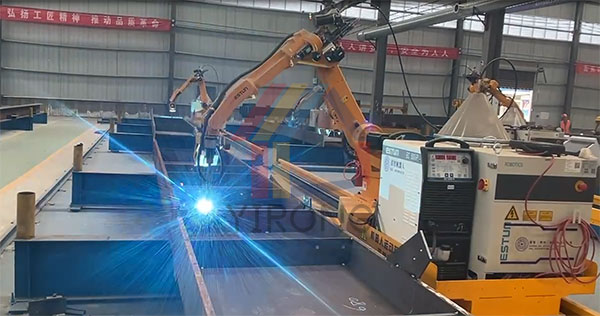
Welding quality directly determines the load-bearing capacity of the steel structure and is the core control point of the entire process. Modern enterprises commonly employ mixed-gas welding technology, coupled with automated welding robots, to achieve full, uniform, and smooth welds. Before welding, process qualification is required to clarify parameters such as welding current, voltage, and interpass temperature. When the ambient temperature is below 5℃ or the relative humidity is above 80%, heating and dehumidification measures are necessary. For critical welds in the Manila super high-rise project, 100% non-destructive testing is required. Welders must be certified, and the same part cannot be reworked more than twice. In overseas projects such as the Saudi Arabian Royal Tower, welding materials are optimized for high-temperature environments to prevent weld cracks.
III. Quality Assurance
High-quality steel structures must not only be aesthetically pleasing but also durable. Inspection and post-processing are the last line of defense for ensuring long-term safety.
3.1. Non-Destructive Testing
Non-destructive testing is the “seeing eye” of steel structure quality control, detecting internal defects without damaging the components. Current mainstream technologies form a complementary system:
Ultrasonic testing, with its high-resolution probes, can identify internal cracks as small as 0.1mm, increasing efficiency by 80% compared to manual methods.
X-ray inspection uses a 4000×4000 pixel detector, capable of detecting minute inclusions as small as 0.2 mm², reducing radiation dose by 50%.
Magnetic particle inspection targets ferromagnetic materials and can detect surface cracks as wide as 0.05 mm.
Penetrating agent testing is suitable for non-magnetic materials, doubling its ability to identify open defects as small as 0.01 mm.
Institutions like CTI (China Testing & Certification) upload inspection data to the cloud in real time, creating traceable digital reports to ensure every weld is documented.
3.2. Straightening and Corrosion Protection
Welded components are prone to deformation and require mechanical or flame straightening to restore accuracy. The geometric deviations of the straightened components must meet design requirements. Corrosion protection directly affects the service life of steel structures, especially in coastal or high-humidity areas. Canglong Steel Structure employs a dual rust removal process of high-pressure cleaning and manual finishing to thoroughly remove oxide scale and impurities, followed by application of high-quality alkyd anti-rust paint to form a tight protective layer. For overseas projects, anti-corrosion solutions are adjusted according to local climates. For example, in Southeast Asia, coating thickness is increased to enhance resistance to salt spray corrosion.
IV. Finished Product Delivery
Steel structure components, having undergone multiple processes, require rigorous acceptance, standardized packaging, and precise transportation to ultimately realize their design value.
4.1. Finished Product Inspection and Traceability
Before leaving the factory, finished products undergo comprehensive inspection, including dimensional verification, visual inspection, and anti-corrosion layer thickness testing. All indicators must meet design standards and industry specifications. Modern enterprises commonly use BIM and QR code management models, with each component corresponding to a unique QR code. Scanning the code allows access to processing information, test reports, installation location, and other data, enabling full lifecycle traceability from raw materials to installation. Qualified components are clearly labeled for easy on-site identification and installation.
2. Packaging, Transportation, and On-site Coordination
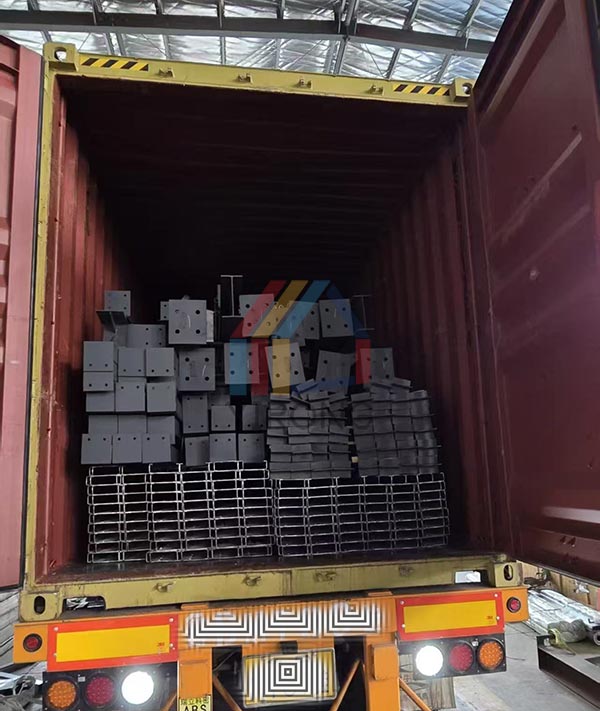
Component packaging is customized according to shape and weight, employing moisture-proof and collision-proof measures to prevent damage during transportation. For overseas projects in the Philippines and New Zealand, companies like Jinggong Steel Structure coordinate shipping cycles with on-site construction schedules, using modular transportation solutions to reduce on-site assembly time. Upon arrival at the construction site, precise positioning and installation are achieved using a BIM model. Real-time feedback from the on-site quality control system ensures installation accuracy and structural safety.
V. Industry Trends
Currently, steel structure manufacturing is upgrading in two main directions: First, greening, reducing waste through the use of recyclable steel and optimized nesting processes, some companies have already increased steel utilization rates to over 90%. Second, intelligentization, with digital production lines achieving full automation from design to processing. Technologies such as robotic welding and intelligent inspection significantly improve efficiency and quality. With the advancement of the “Belt and Road” initiative, Chinese steel structure companies, leveraging their technological advantages, are emerging in global landmark projects, promoting the international integration of high-quality steel structure manufacturing standards.
From micron-level cutting precision to comprehensive non-destructive testing, from BIM’s digital empowerment to full-process quality traceability, the manufacturing process of high-quality steel structures is a perfect combination of technological innovation and unwavering craftsmanship. This mature process system not only supports skyscrapers and stadiums but also drives the global construction industry towards a safer, more efficient, and greener future.