Why is growing appetite for fire-safe rock wool panels in the Middle East and Africa construction?
In the Middle East and Africa, two emerging construction markets with immense development potential, the choice of building materials for exterior wall and roof cladding systems is undergoing a historic transformation. The explosive growth in demand for fire-safe rock wool panels in this region is no accident, but rather the inevitable result of the combined effects of an energy efficiency crisis spurred by extreme weather, tightening geopolitical fire regulations, and a massive industrial and mega-infrastructure boom.
By 2026, general contractors and engineers in the MEA region are completely abandoning traditional ordinary combustible plastic foam boards, instead adopting rock wool systems with melting points exceeding 1000°C, Class A absolute non-combustibility, and a maximum fire resistance limit of 4 hours as a mandatory standard for steel structure buildings. This is the only solution for the region to lock in asset security and reduce total life-cycle operating costs (OPEX) while pursuing high-turnover economic expansion.
The following is a step-by-step in-depth analysis combining the latest construction supply chain, fire protection laws, and steel structure engineering in the Middle East and Africa.
Middle East Market (GCC Countries)
The Gulf Cooperation Council (GCC) member states, including Saudi Arabia, the UAE, and Qatar, are currently in the peak delivery period for national mega-projects such as “Vision 2030.” Their demand for rock wool stems from the following two mechanisms:
1. Alignment with International Fire Protection Codes (e.g., UAE/Saudi Arabia Fire Safety Code)
Historically, the Gulf region has experienced numerous “three-dimensional” fire disasters caused by the use of combustible sandwich panels (such as ordinary polystyrene EPS) in the exterior walls of high-rise buildings or large industrial structures.
In 2026, GCC countries comprehensively tightened their Building Product Regulations (CPR). The new regulations strictly align with the European standard EN 13501-1 (A1 non-combustible) and the American standard ASTM E136 fire protection standard. In high-risk locations such as high-density logistics parks, desalination plants, and petrochemical workshops, it is mandatory to use Class A high-density fire-safe rock wool panels that produce zero smoke and zero open flame drips for the outer shell.
2. Green Energy Efficiency to Withstand 50°C Extreme Heat Waves
Middle Eastern summer temperatures frequently exceed 50°C, making the electricity costs for central air conditioning in steel structure factory building astronomical.
High Airtight Insulation: Countless inorganic mineral fibers intertwine three-dimensionally and multi-directionally within the rock wool sandwich panels, trapping numerous stationary micro-air chambers.
Cut Electricity Costs by 35%: While providing 4 hours of extreme fire protection, it constructs a robust heat insulation barrier, completely preventing external heat waves from penetrating the interior, directly reducing summer air conditioning operating expenses (OPEX) by more than 35% for Middle Eastern factory owners.
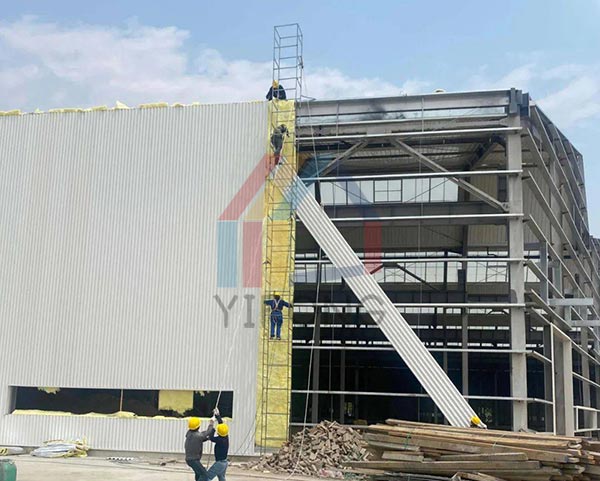
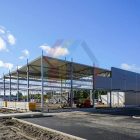
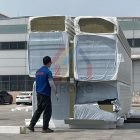
Rock Wool Panels Installation for Steel Factory Building
The African Market
Unlike the luxury and high energy efficiency of the Middle East, the growing demand for rock wool boards in the African construction industry (such as Congo, Nigeria, Ethiopia, and Kenya) is driven more by the international relocation of manufacturing and the rapid advancement of new industrialization.
1. Compliance and Risk Control for International Investment Multinational Corporations
By 2026, a large amount of multinational capital from China, Europe, and North America will enter Africa to build modern auto repair shops, food processing plants, textile workshops, and modern multi-span industrial parks.
These projects must meet the safety compliance requirements of international insurance companies and their home countries from the initial design stage (such as the US standard IFC Section 703 fire barrier integrity requirements). To pass cross-border acceptance and reduce insurance premiums, general contractors directly lock in Class A non-combustible rock wool systems for the steel structure outer shell.
2. A Win-Win Situation for Fire Resistance and Acoustic Performance
Many new steel structure factories in Africa are labor-intensive workshops with heavy machinery operating noisily inside.
The dense, porous mesh structure of rock wool acts as a natural acoustic noise barrier. Using rock wool sandwich panels as wall cladding not only solves serious fire hazards but also significantly absorbs high-decibel noise in workshops, greatly optimizing the occupational health environment and aligning with modern sustainable building (ESG) development standards.
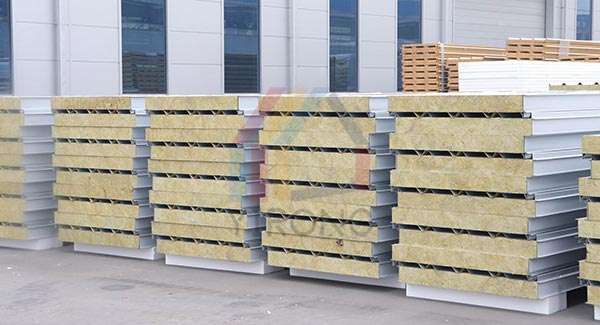
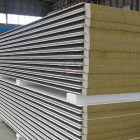
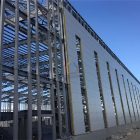
Rock Wool Sandwich Panels for Roofing
Upgrade Solutions for the Steel Building Industry in the MEA Region
Due to the Middle East’s frequent exposure to high-salt-spray sea winds and parts of Africa experiencing heavy rainfall and high humidity, traditional pure fire-safe rock wool panels have inherent physical drawbacks: easy water absorption at the tongue-and-groove joints, slightly weaker airtightness, and potential shrinkage over long-term use.
To perfectly align with the stringent fire safety regulations of the Middle East and Africa while also meeting the extreme requirements for waterproofing and weather resistance in island, coastal, and tropical climates, the construction industry in the MEA region will fully promote polyurethane edge-sealed rock wool sandwich panels by 2026.
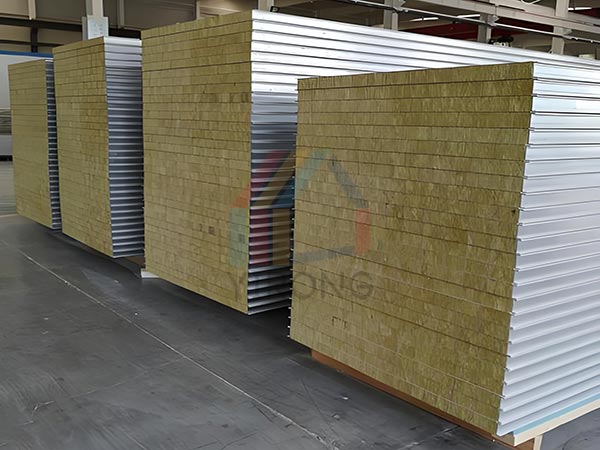
Core Fireproof Zone (Class A Rock Wool): The center of the panel is 100% made of high-density inorganic rock wool with a melting point exceeding 1000°C and a fire resistance time of up to 4 hours, firmly adhering to fire safety standards.
Edge Sealing Area (PU Rigid Edge Sealing): Utilizing a fully automated continuous production line, rigid high-density polyurethane (PU) is precisely injected into both sides of the tongue and groove joints of the panels.
Core Value for MEA Users: The high closed-cell rate of polyurethane completely blocks the erosion of internal rock wool fibers by external moisture and sea breeze chloride ions, eliminating the “cold bridge effect.” This ensures that the building has more than four times the fire resistance while guaranteeing a long-lasting insulation lifespan of several decades.
How does Yirong Group achieve one-stop factory construction in the Middle East and Africa?
As a global expert in steel structure system integration and green building material solution delivery, Yirong Group has already established a closed-loop export channel for buyers and contractors in the Middle East and Africa through a digitalized entire industry chain.
Authoritative International Certifications: Yirong’s rock wool and polyurethane-sealed rock wool sandwich panels have all passed authoritative international certifications such as CE, SGS, and ISO, fully aligning with ASTM E136 and EN 13501-1 standards, ensuring hassle-free customs clearance at the destination port and one-time acceptance by the local fire department.
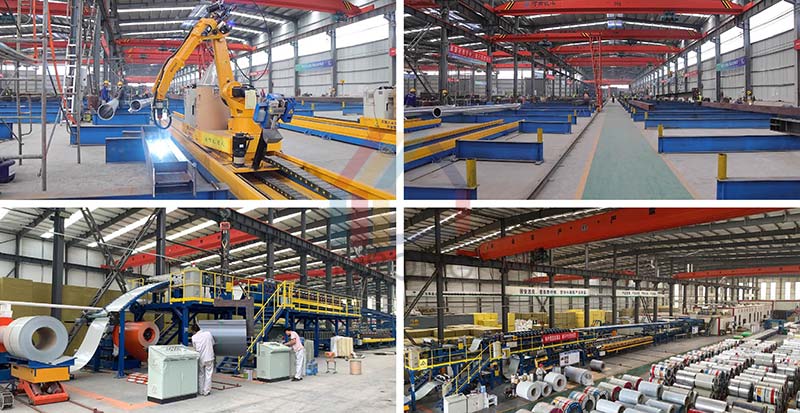
Digital Factory, 100% Prefabrication, Halving On-Site Construction Time: The MEA region generally faces the challenges of a shortage of highly skilled construction workers and high local construction costs. Yirong uses automated welding robots to precisely weld and punch holes in the main steel structure (Q355B H-shaped steel beams and columns) in the factory, ensuring precise alignment of the outer fire-safe rock wool panels. Upon arrival on-site, the entire assembly is done using a bolted “modular” method, eliminating 100% welding on-site and directly shortening the factory construction time by more than 50%.
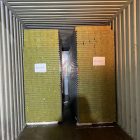
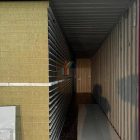
Complex Logistics Convergence Between Africa and the Middle East: Primary and secondary steel structures, high-fire-resistant rock wool enclosures, drainage systems (gutters and downpipes), high-strength roller shutters and windows, and all high-strength bolts and accessories are uniformly packaged into 40HQ containers by Yirong’s factory and scientifically shipped according to the construction sequence. This completely avoids the black hole risk of indefinite work stoppages caused by “missing or under-shipped parts” discovered on-site overseas.
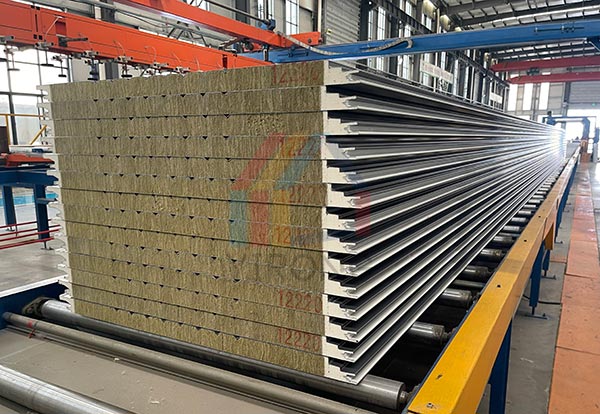
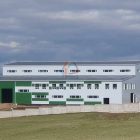
Sandwich Panel and Steel Structure Production Workshop
Conclusion
Choosing fire-safe rock wool panels system is an inevitable awakening for the Middle East and African construction industry in the tide of globalization and standardization. Choosing a one-stop partner (such as Yirong Group) with extensive global delivery experience and the ability to provide 100% factory prefabrication and high-end full enclosure not only ensures safety and compliance under stringent legal regulations but also provides a golden investment channel to maximize the ROI and achieve long-term high turnover for your industrial assets in the MEA region.