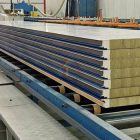
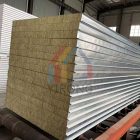
How to choose insulation panels for steel workshop at -20℃?
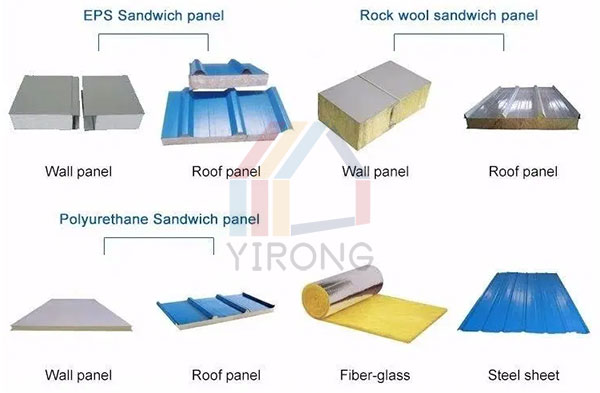
In regions with extremely low winter temperatures, such as Russia, Canada, and Northern Europe, the core challenge in steel workshop construction is balancing the need to withstand severe cold and reduce heating energy consumption with ensuring the stability and durability of materials during freeze-thaw cycles. Sandwich panels are the mainstream insulation material for workshop walls and roofs, and choosing the right type directly determines the success or failure of the project. This article compares the performance of four types of sandwich panels—EPS, rock wool, PU, and glass wool—in a -20℃ environment, based on actual user needs.
I. Three Core Challenges of Steel Workshop at -20℃
Users commonly face the following challenges in building low-temperature workshops:
Energy Consumption Pressure: In a -20℃ environment, heating energy consumption accounts for more than 40% of workshop operating costs. Insufficient insulation performance will lead to a surge in annual energy costs.
Risk of Material Freezing Damage: Low temperatures easily cause materials to become brittle, absorb water, freeze, and expand (such as ordinary rock wool), leading to wall cracking and insulation failure.
Compliance Threshold: EU EN 13501 and North American NFPA regulations require insulation materials for low-temperature workshops to possess both high-efficiency insulation and Class A fire resistance.
II. Real-world Performance of Four Types of Sandwich Panels at -20℃
Low-temperature brittleness: Easily hardens and cracks below -15℃, prone to breakage during winter construction in northern regions, and long-term use leads to increased air leakage and energy consumption.
Fire resistance defects: Class B flame retardant (difficult to burn), does not meet EU Class A and North American Class A fire resistance requirements, and workshops storing chemicals will fail inspection.
High water absorption (>2%): Water freezes and expands at low temperatures, further damaging the panel structure.
Conclusion: Only suitable for temporary construction in non-cold regions; use with caution in workshops at -20℃.
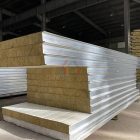
2. Rock Wool Sandwich Panels
Advantages: Class A fire resistance (inorganic materials are non-combustible), high temperature resistance, suitable for workshops with extremely high fire safety requirements.
Low Temperature Disadvantages:
High water absorption (moisture absorption rate > 5%): At -20℃, internal moisture freezes, with a volume expansion rate of up to 9%, easily leading to delamination between the core layer and the panel, and voids in the insulation layer.
Insulation degradation: After absorbing water, the thermal conductivity increases sharply (from 0.044 to 0.07 W/(m·K)), halving the actual insulation effect.
Construction limitations: High density (80-120kg/m³), requiring heavy equipment for installation, resulting in low cost-effectiveness due to high labor costs.
Conclusion: Only suitable for dry, low-rainfall, low-temperature areas; not recommended for high-humidity/snowy environments (such as the Nordic coast).
3. PU Sandwich Panels (Polyurethane)
Advantages: Optimal thermal insulation performance (λ≈0.022-0.028 W/(m·K)), 30% thinner than glass wool for the same thickness, suitable for space-constrained workshops.
Low-Temperature Limitations:
High Price: Costs 1.5-2 times that of glass wool, difficult to afford for budget-sensitive overseas projects.
Fire Safety Controversy: Ordinary PU is B1 grade (flame-retardant), requiring the addition of flame retardants to achieve A grade, but this may affect thermal insulation performance.
Conclusion: Suitable for ultra-low temperature (below -30℃) laboratories with extremely high space requirements and sufficient budget; not cost-effective for conventional -20℃ workshops.
4. Glass Wool Sandwich Panels
Core Advantages:
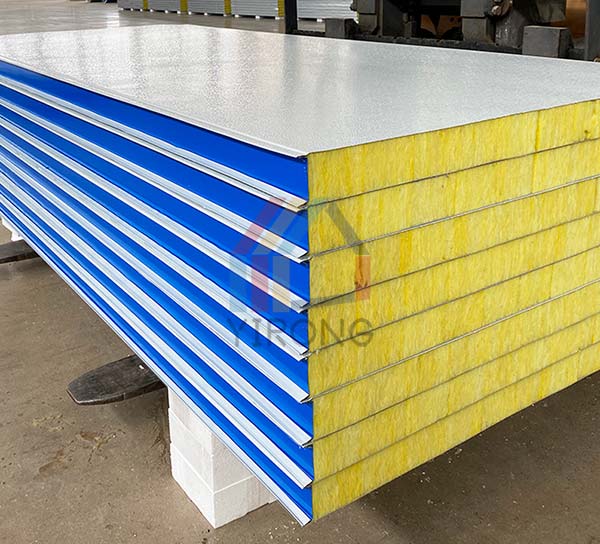
Stable Thermal Insulation: Thermal conductivity λ=0.032-0.040 W/(m·K), remaining stable even at -20℃. Combined with the exterior finish, it forms an air insulation layer. Actual heating energy consumption is 25% lower than EPS and 15% lower than rock wool.
Freezing and Moisture Resistance: Yirong uses hydrophobic glass wool (moisture absorption rate <0.5%), preventing moisture from freezing and expanding at low temperatures, thus avoiding cracking. The fiber structure is reinforced, maintaining toughness even at -40℃, with no risk of embrittlement.
Fire Compliance: Class A non-combustible (EU Class A1, North American FM certification), workshops storing flammable materials can directly pass fire safety inspections.
Lightweight and Quick Installation: Density only 40-60kg/m³ (only 50% of rock wool), modular design supports factory prefabrication and on-site assembly, with daily installation exceeding 500㎡, 40% faster than rock wool.
III. Customized Solutions for -20℃ Steel Workshops
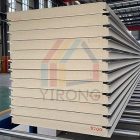
To address the specific needs of users in low-temperature workshops, Yirong offers glass wool sandwich panels with the following core optimizations:
1. Material Formula Specifically Designed for -20℃
Upgraded Water Repellency: Treated with nano-level water-repellent agents, water absorption rate <0.3%, eliminating the risk of freezing.
Fiber Reinforcement: Increased basalt fiber ratio enhances the tensile strength of the panels, resisting low-temperature freeze-thaw cycles.
Certified by EU CE, German TÜV, and North American FM Global, with fire resistance ratings of A1 (EN 13501) and Class A (ASTM E84), meeting the stringent regulations of major markets such as the EU, North America, and Russia.
3. Service Support
Free thermal calculations (based on local meteorological data) and installation guidance videos are provided to reduce the difficulty of project implementation.
IV. Conclusion
For constructing steel workshop in areas with temperatures as low as -20°C, Yirong glass wool sandwich panels have become the optimal solution for users due to their comprehensive advantages, including stable insulation, strong freeze resistance, fire resistance compliance, and controllable costs. Whether for automobile manufacturing, food processing, or warehousing and logistics workshops, Yirong can provide customized solutions to help projects achieve low energy consumption and high reliability operation under extreme low temperatures.