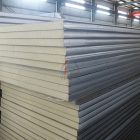
Why puf panels are the smart investment for your cold storage facility?
Amid surging cold chain demand and rising energy costs, cold chain operators face a critical decision: cut insulation costs and risk inefficiency, or invest in materials that deliver long-term value? Among the many options, PUF panels have become the industry benchmark.
1. Unparalleled Insulation Efficiency
What is the largest operating cost for cold storage facilities? The answer is energy. Cooling systems account for 30%-50% of total energy consumption, and even minor insulation deficiencies can lead to significant long-term costs. PUF panels can address this issue.
Industry-leading thermal resistance: PUF sandwich panels have a thermal conductivity (λ) of only 0.022-0.024 W/(m·K) and a thermal resistance (R-value) of 20-25 ft²·h·°F/Btu per inch. This performance far exceeds that of traditional materials. For example, the insulation efficiency of expanded polystyrene (EPS, λ = 0.038-0.042 W/(m·K)) is 40% lower, and that of glass wool (λ = 0.038-0.045 W/(m·K)) is 50% lower.
Real-world proof: A 2023 US Cold Chain Association case study showed that a 500,000-square-foot frozen food warehouse in Texas reduced its annual cooling costs by $42,000 (a 38%) after upgrading from EPS sandwich panels to 100mm-thick PUF sandwich panels. In warmer regions like Florida, the energy savings are further increased to 50% due to PUF’s greater resistance to heat absorption.
For operators, this means a faster payback period. Most PUF panel projects recover the initial material premium through energy savings in just 2-3 years, and continue to enjoy low-cost operations for over 20 years.
2. Durability Far Exceeds Traditional Materials
Cold storage environments are extremely harsh: sustained low temperatures, high humidity, and the corrosive effects of chemicals like cleaning agents and food residue place severe strains on insulation materials. PUF sandwich panels are specifically designed for these environments.
Excellent Moisture Resistance: Unlike EPS (which absorbs 3%-5% water in high humidity, reducing insulation performance) or glass wool (which is susceptible to mold and rot), PUF’s closed-cell structure (90%-95% closed-cell ratio) keeps water absorption below 1%. This prevents thermal bridging, which can cause hot spots in damp insulation and overload the cooling system.
High Corrosion Resistance: PUF panels utilize galvanized steel (zinc layer weight ≥ 275g/m2) or aluminum-magnesium-manganese alloy panels, resisting rust, salt spray (critical for coastal facilities), and chemical attack. In contrast, cheap steel or unprotected aluminum will degrade in 5-7 years in harsh environments.
Excellent Impact Resistance: PUF core material has a density of ≥40 kg/m³, making it highly rigid and able to withstand impacts from forklifts, equipment, or accidental collisions. Fragile EPS, however, is susceptible to cracking under pressure, reducing repair costs and downtime.
A European cold chain operator reported a 60% reduction in maintenance costs since switching to PUF panels 10 years ago, primarily due to the near-zero degradation of the insulation layer, which significantly outperformed the previous glass wool system.
3. Compliance and Safety
Cold storage facilities must adhere to stringent safety and hygiene standards, from the US FDA Food Code to the EU General Food Directive. PUF panels can simplify the compliance process.
Fire Safety: Most PUF sandwich panels meet global fire ratings (such as B1 flame retardancy according to EU EN 13501-1 and B-s1,d0 according to China GB 8624). Their low smoke emissions (<50 m²/kg) and self-extinguishing properties reduce fire risks, which are crucial for insurance approval and liability avoidance.
Hygienic Design: PUF’s metal panels have a smooth, non-porous surface, preventing bacterial growth and can be cleaned directly with standard disinfectants (without absorbing chemicals or pathogens). This fully complies with HACCP (Hazard Analysis and Critical Control Point) requirements for the food, pharmaceutical, and medical cold chains.
Structural Strength: PUF panels can withstand extreme loads (snow accumulation, strong winds, and equipment pressure) without collapsing or deforming. For example, a 150mm thick PUF sandwich panel meets US building code requirements for roof snow loads (50 psf, approximately 2.4 kN/m²) and wind speeds (150 mph, approximately 240 km/h). This is particularly critical for facilities in hurricane-prone areas like Florida or typhoon-prone areas in Southeast Asia.
4. Fast Installation and Lower Labor Costs
Time is money, especially when constructing new cold storage facilities or expanding existing ones. PUF sandwich panels can significantly shorten construction timelines.
Integrated Design: Unlike traditional systems (such as separate metal panels and glass wool), PUF panels integrate insulation and exterior cladding. This eliminates the need for laying moisture-proof membranes, sealing seams, and aligning multiple layers, reducing installation time by 30%-50%.
Precision Prefabrication: PUF sandwich panels are prefabricated in the factory to precise dimensions (tolerance ≤ 2mm), reducing on-site scrap and ensuring seamless joints. For large facilities, this minimizes errors and rework.
Modular and Flexible Expansion: Need to expand in the future? PUF sandwich panels can be easily disassembled and reinstalled, reducing future upgrade costs.
A Canadian logistics company recently completed a 200,000 square foot cold chain expansion using PUF panels in just 12 weeks, 10 weeks faster than a traditional project, saving $80,000 in labor and management costs.
5. Long-Term Return on Investment
Let’s break down the numbers:
Cost Factor
Traditional Insulation (EPS)
PUF Panels
Initial Material Cost
$15/sq.ft.
$18/sq.ft. (+20%)
Installation Labor
$10/sq.ft.
$7/sq.ft. (-30%)
Annual Energy Cost
$8/sq.ft.
$4.5/sq.ft. (-44%)
10-Year Maintenance
$12/sq.ft.
$3/sq.ft. (-75%)
For a 100,000 square foot facility, using PUF panels over EPS can save $3.1 million over 10 years, despite the 20% higher initial cost.
Conclusion
For cold chain operators, PUF panels are more than just insulation; they represent a strategic investment in efficiency, durability, and profitability. By reducing energy consumption, minimizing maintenance, simplifying regulatory compliance, and accelerating construction, the return on investment of PUF sandwich panels far exceeds other options.
In an industry where margins are razor-thin and downtime is costly, choosing PUF panels is the smartest strategy for future-proofing your facility. Ready to reduce costs and improve performance? Choose PUF—your bottom line will thank you.