How to build an industrial workshop exceeding 10,000 square meters?
Industrial workshops are the core carriers of manufacturing. A large workshop exceeding 10,000㎡ must balance functionality, efficiency, and compliance. The following summarizes a reusable construction logic based on experience from multiple industries, covering the four stages of planning, design, construction, and operation.
I. Pre-Planning
Failures in large workshops often stem from poor planning. The pre-planning phase must address three core questions:
1. Define Production Needs
Industry Specifics: Automotive/mechanical workshops require large spans (30–50 meters) and high clear heights (8–12 meters); electronic/pharmaceutical workshops need cleanliness grades (Class 10,000/1,000) and constant temperature/humidity; chemical workshops require explosion-proof and anti-corrosion features.
Capacity and Process: Calculate the number of production lines and equipment dimensions based on product types, such as a 3×5 meter foundation for injection molding machines, reserve 20% expansion space.
Logistics Efficiency: Raw material/finished product transport paths should be short and smooth with no crossings. Plan track positions in advance for large equipment (e.g., gantry cranes).
2. Site Selection
Land Conditions: Prioritize flat plots (slope < 2%), avoiding seismic zones/flood-prone areas. Conduct geological surveys in soft soil regions.
Infrastructure: Confirm electricity, water supply, drainage, and roads (at least 9-meter-wide truck access).
Policy Restrictions: Monitor local industrial plans, plot ratios, and building height limits (≤24 meters or restricted zones).
II. Design Stage
Designing a large workshop requires balancing current needs with 5–10 years of future upgrades. Key actions include:
1. Structural Selection
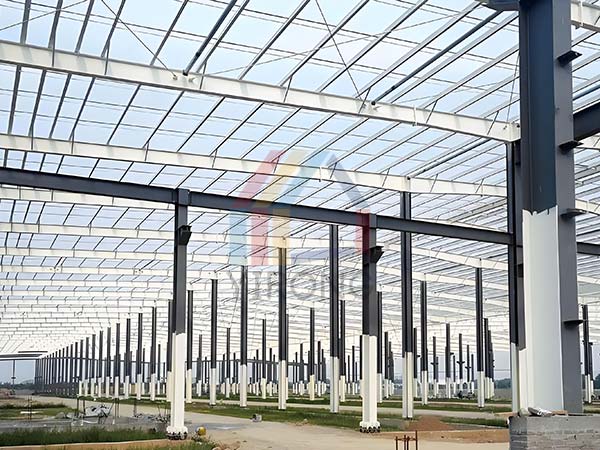
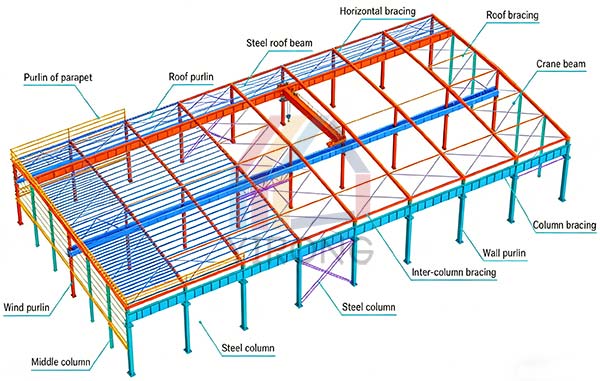
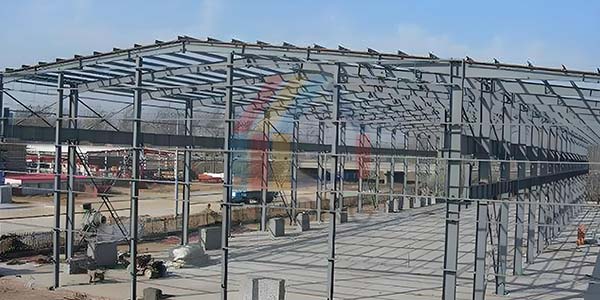
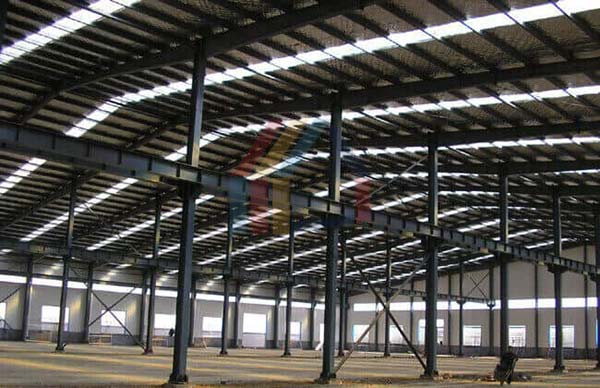
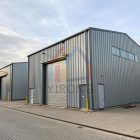
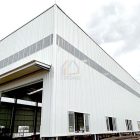
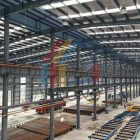
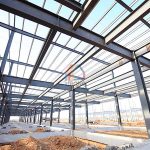
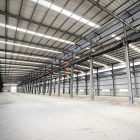
Light Steel Structure: Mainstream solution, spanning up to 60 meters with a short construction period (3–6 months). Ideal for mechanical/electronic workshops without heavy equipment.
Concrete Frame + Steel Roof Truss: Strong load-bearing capacity, suitable for chemical/metallurgical workshops, but 15%–20% more expensive than steel structures with a longer period (6–9 months).
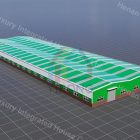
Modular Design: Prefabricate columns, beams, and roof panels for on-site assembly, reducing welding and shortening construction time.
2. Functional Zoning
Production Area: Arrange by process flow (e.g., “raw materials → processing → assembly → quality inspection”). Maintain ≥1.5 meters between equipment. Heavy equipment requires independent foundations.
Auxiliary Area: Warehouses, tool rooms, changing rooms, and hazardous chemical storage (independent fire compartments).
Management Area: Offices/control rooms need full workshop visibility. IT server rooms require electromagnetic interference protection.
3. Green and Smart
Energy-Saving Design: Install PV panels on roofs, use rock wool insulation for exterior walls, and incorporate natural lighting.
Smart Systems: Deploy BMS (Building Management System) to monitor temperature/humidity/energy use, AGV scheduling systems to optimize logistics, and 5G+IoT for real-time equipment status tracking.
III. Construction Stage
Large workshops face delays due to scale and coordination challenges. Focus on:
Equipment foundations need separate pouring, reserved anchor bolt holes, and a curing period over 28 days.
2. Main Structure
Steel component installation error ≤3mm (for 50-meter spans). High-strength bolt torque must be 100% inspected.
Control cracks in concrete frames. For large-volume concrete (>1 meter thick), use layered pouring + cooling pipes.
3. Mechanical, Electrical, and Finishing
Electrical wiring in galvanized steel pipes, reliable grounding of cable trays. Fire pipelines undergo 1.5x working pressure testing.
Floor Treatment: Ordinary workshops use emery wear-resistant flooring, clean workshops use epoxy self-leveling flooring.
IV. Compliance and Acceptance
All large workshops must pass three key certifications globally:
Safety: Fire acceptance (extinguisher/sprinkler density per GB50016 Code for Fire Protection Design of Buildings), lightning protection testing, 100% air terminal coverage.
Industry-Specific Requirements: Food workshops need SC certification, pharmaceutical workshops need GMP certification (air cleanliness meets standards).
V. Cost Control
Total investment for a 10,000+㎡ workshop typically ranges from 80 million to 200 million RMB. Optimize via:
Standardize components to cut mold costs.
Procurement: Centralize steel/cement purchasing, replace imports with domestic equipment.
Construction: Complete outdoor works before rainy seasons to avoid delays.
Summary
The core of building an industrial workshop of over 10,000 square meters is to design backward from production needs, use modularity and intelligence to improve flexibility, and at the same time ensure efficiency through compliance control and long-term cost control. Whether it is an automobile giant or an emerging manufacturing company, following this logic can efficiently implement high-quality workshops.