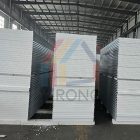
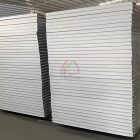
How to choose the right insulating sandwich panels for prefab warehouse building?
When choosing insulating sandwich panels for prefab warehouse building, consider the three key factors of durability, safety, and cost-effectiveness, taking into account actual needs.
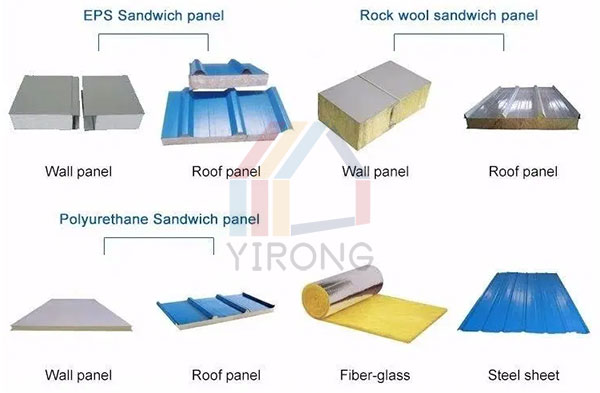
First, consider insulation performance. The insulation capacity of a sandwich panel is primarily determined by the core material: Polyurethane (PU) has the lowest thermal conductivity and offers the best insulation in winter and summer. Extruded polystyrene (XPS) is second best and is suitable for areas with limited temperature fluctuations. Polystyrene (EPS) is low-cost but offers slightly lower insulation performance and is often used in small warehouses with limited budgets. If the warehouse needs to store temperature- and humidity-sensitive goods such as pharmaceuticals and food for a long period of time, polyurethane or XPS is preferred.
Second, consider fire safety. Different regions have strict fire safety requirements for buildings, and local regulations must be met. Rock wool core material is a non-combustible material (Class A fireproof) that does not burn or release toxic gases at high temperatures, making it suitable for chemical warehouses or areas with strict fire safety requirements. Glass wool, while also fireproof, is less strong and easily deforms due to moisture absorption. Polyurethane and polystyrene are inherently flammable, so modified products with added flame retardants (up to B1 grade) should be selected and avoided in flammable material warehouses.
Next, consider durability. The outer layer of metal-faced sandwich panels (such as color-coated steel or aluminum-zinc panels) must be corrosion-resistant and weather-resistant. Especially in coastal areas with high humidity or acid rain, aluminum-zinc-coated steel or fluorocarbon-coated panels should be selected to reduce the risk of rust and cracking. If the inner layer comes into contact with goods, it must be smooth and easy to clean (such as stainless steel) to avoid dust or liquid residue.
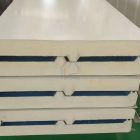
Finally, consider the overall cost. Based on price alone, EPS is the cheapest, while PU and rock wool are more expensive. However, the full lifecycle cost must be considered. While PU panel is initially more expensive, its excellent insulation reduces air conditioning energy consumption, while rock wool’s fire resistance reduces subsequent remediation costs. Furthermore, panel thickness and joint method (whether tongue-and-groove is waterproof) will affect installation efficiency and long-term sealing. Confirm with the supplier in advance whether the panels are compatible with the warehouse size.
In short, the most suitable insulating sandwich panels can be selected based on the warehouse’s climate (cold/hot/humid), the type of stored goods (normal/flammable/sensitive), local fire protection regulations, and the balance between insulation, fire protection, durability and cost.