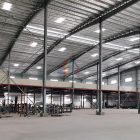
How to ensure that the warehouse has a long service life?
To ensure that the warehouse has a long service life, it is necessary to comprehensively consider the four dimensions of scientific selection of construction materials, rationality of structural design, standardization of the use process, and systematic maintenance system. At the same time, adaptive strategies should be formulated in combination with environmental differences in different regions of the world (such as climate, industrial pollution, natural disasters, etc.).
1. Construction materials
The life of a warehouse depends first on the tolerance of the material to the environment. Different regions of the world face extreme climates (such as tropical high humidity, coastal salt spray, freeze-thaw cycles in cold areas, desert sand erosion), industrial pollution (acid rain, chemical corrosion) or biological invasion (termites, mold), and the materials must have three core characteristics: strong weather resistance, corrosion resistance, and structural stability.
1.1 Global adaptability of mainstream materials
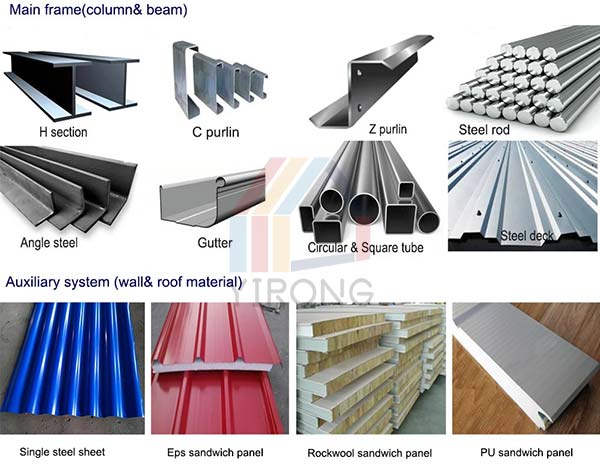
Galvanized steel (such as Q235B/Q345B galvanized H-beam, square tube): The zinc layer isolates the steel from external corrosive media (water, oxygen, salt ions) through electrochemical action. In scenes such as the seaside (salt spray environment) and industrial areas (acidic gas), the zinc coating thickness ≥80μm (national standard GB/T 13912-2020) can extend the life of the steel to more than 30 years (ordinary steel is only 5-10 years).
Color-coated steel plate/EPS purification board: The surface PVDF/PE coating can resist ultraviolet aging (weather resistance ≥20 years), and the EPS core material has a low thermal conductivity (≤0.041W/(m·K)), which has the advantages of both insulation and lightweight, and is suitable for scenes that require temperature control such as cold storage and constant temperature warehouses.
Composite plates (such as aluminum-magnesium-manganese alloy + insulation cotton): In cold areas (below -40℃), it can avoid low-temperature embrittlement of steel, and reduce the damage to the structure caused by thermal expansion and contraction through the insulation layer.
1.2 Yirong Steel Structure Material Strategy
Yirong provides customized material packages for different regions around the world:
Coastal areas use hot-dip galvanizing + aluminum-zinc alloy coating (the corrosion resistance of zinc-aluminum-magnesium coating is 3-5 times that of pure zinc).
In industrial pollution areas, fluorocarbon coated color steel plates are used (acid and alkali resistance is improved by 40%).
Q355D low-alloy high-strength steel (low-temperature impact toughness ≥27J) is used in cold areas/freeze-thaw areas to avoid cracking of steel due to repeated freezing and thawing.
2. Structural design
The structural design of the warehouse needs to take into account the load-bearing capacity, disaster resistance (wind, earthquake, snow load), spatial adaptability, and comply with the international/national standards of the target market (such as European and American EN 1090, American AISC, and Chinese GB 50017) to avoid local stress concentration or insufficient bearing capacity due to design defects, which shortens the overall life.
2.1 Key design points
Load redundancy: Design according to the use load × 1.5 times the safety factor (such as the conventional storage load of 5kN/㎡, the design value is 7.5kN/㎡), to avoid deformation or collapse of beams and columns caused by overload.
Wind/seismic optimization: Truss roof trusses + bolted connection nodes are used in coastal typhoon areas (such as Southeast Asia) (can withstand ≥12 winds). Flexible frame structures are used in earthquake zones (such as South America and Japan) (ductile design allows the structure to produce controllable deformation in earthquakes without collapse).
Ventilation and moisture-proof design: Warehouses in tropical areas are equipped with high side windows + roof ventilators (reducing internal humidity ≤ 70% to avoid corrosion of steel condensation water), and the ground is made of waterproof membrane + concrete cushion (the thickness of the moisture-proof layer is ≥ 50mm).
2.2 Yirong’s structural design advantages
Yirong relies on the engineering case library of more than 120 countries in the world and adopts BIM full-cycle design software (such as Tekla, Revit). Customize the structural plan based on the meteorological data of the project location (such as wind load, snow load, earthquake intensity), and pass the certification of third-party organizations (such as SGS, TÜV) to ensure that the design complies with local regulations. For example, the double-layer color steel plate + insulation cotton roof designed for a warehouse in a desert area in the Middle East can reduce the indoor temperature by 15℃ and reduce the risk of loose connection caused by high-temperature expansion of steel.
3. Use process
The actual use habits of the warehouse directly affect the lifespan. Improper operation (such as overloading, sharp objects hitting the wall, and arbitrary modification of the structure) will lead to local stress concentration, material fatigue or structural damage, shortening the overall lifespan.
3.1 General specifications for global users
Load control: Strictly stack goods according to the design load partition (such as heavy goods close to the column grid, light goods on the upper layer), and it is prohibited to exceed 10% of the design value.
Physical protection: Install anti-collision guards (such as rubber strips, steel plate corner guards) on the wall to prevent the color steel plate from being sunken due to collisions with equipment such as forklifts.
Environmental control: Keep the warehouse ventilated (natural or mechanical ventilation), control the humidity ≤ 75% (can be achieved by dehumidifiers), and avoid steel rust.
Prohibited modification: Non-professional designers are not allowed to cut steel components, remove supports or change the roof slope without authorization (which may damage the integrity of the structure).
3.2 Solutions of Yirong Steel Structure Supplier
Yirong provides customers with a full life cycle use guide (including graphic manuals and video tutorials), and customizes operating specifications for different industries (such as food, cold chain, and chemical industry). For example, it is recommended to add local anti-corrosion coatings to mark the corrosion-prone areas (near the cold storage door) of food factory warehouses. Provide explosion-proof wall renovation solutions for chemical warehouses (add galvanized steel plates + fireproof cotton) to prevent chemical leakage and corrosion of structures.
4. Maintenance system
Even if the materials and designs are of high quality, local problems will still occur after long-term use due to environmental erosion (such as rust, coating aging) or accidental damage (such as scratches, impacts), and regular maintenance and repair are required to prevent small problems from turning into structural hazards.
4.1 Global maintenance cycle and measures
Annual inspection (must be done): Check whether the galvanized layer of steel components has fallen off (focus on welds and bolt connections), whether the color steel plates have perforations/deformations, and whether the roof drainage slope is normal (avoid water accumulation).
Deep maintenance every 3-5 years: Grind local rusted parts + epoxy zinc-rich primer + topcoat repair (restore anti-corrosion performance); replace aging sealing strips and waterproof membranes (prevent rainwater leakage).
Emergency maintenance after extreme events: Check whether the structure is deformed after typhoons/rainstorms (such as columns with an inclination of ≥H/150 need to be reinforced) and whether the color steel plate is loose; check whether the bolts at the beam-column node are loose after an earthquake (re-tighten to the design torque).
The long life of a warehouse is the result of multi-dimensional coordination of materials, design, use, and maintenance. As a global leading supplier of warehousing solutions, Yirong Steel Structure Supplier focuses on material corrosion resistance + design redundancy + use specifications + maintenance intelligence. In response to the climate, regulations and user needs of different countries, it provides one-stop services from material customization (such as zinc-aluminum-magnesium coated steel), structural design (in compliance with EN/AISC/GB standards) to full-cycle maintenance (IoT monitoring + emergency response). Its solutions have been implemented in more than 150 countries around the world, extending the service life of warehouses to more than 30 years on average (the industry average is about 20 years), helping customers achieve asset value with one-time investment and long-term benefits.