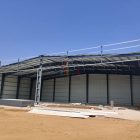
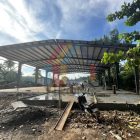
Application of steel frame machine shed in agriculture
In a coffee plantation in Mato Grosso state, Brazil, a German imported cotton picker experienced a 30% increase in maintenance costs due to rusting of its chassis after being parked outdoors for six months. In the Dnieper River plain of Ukraine, a sudden winter snowstorm crushed wooden machinery sheds and damaged 10 tractors with snow. In the Ganges River Plain of India, the continuous rainstorm in the monsoon period reduced the simple iron sheet shed to a leaky warehouse, causing heavy losses of agricultural machinery. These real cases reflect a key pain point in the process of agricultural mechanization, where the storage environment of agricultural machinery is becoming a hidden danger that restricts equipment lifespan, operational efficiency, and farm profits.
The emergence of steel frame machine shed, with innovation in industrial precision and agricultural scenario, is reconstructing the safe haven for agricultural machinery. It is not only a combination of steel and sheet metal, but also a modern agricultural infrastructure to cope with climate change, land resource scarcity, and increased mechanization rate.
1. What is a steel frame machine shed?
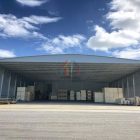
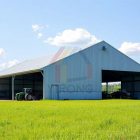
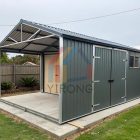
Steel frame machine shed is a modular building with steel structure as the main body (steel columns, steel beams, support system), matched with metal enclosure panels (color steel plates, sandwich panels, rock wool panels, etc.) or transparent materials (sunshine panels, PC panels). The core design of the steel frame shed ranges from large combine harvesters to small seeders, from tropical high humidity environments to cold and snowy climates. Through structural innovation and material adaptation, the shed achieves versatile protection capabilities.
1.1 Core advantages
The traditional storage method of agricultural machinery has obvious defects, but the steel frame machine shed has been solved one by one through technological innovation:
Difficulty
Defects of traditional solutions
Steel frame machine shed solution
Weak corrosion resistance
Outdoor parking is susceptible to erosion from rainwater, fertilizers, and pesticides, resulting in severe rusting of metal components for 3-5 years; Simple shed enclosure board is prone to aging
The steel frame adopts hot-dip galvanizing (galvanized layer ≥ 180g/㎡) or epoxy zinc rich primer for corrosion protection. The enclosure panel can be made of aluminum zinc coated color steel plate (corrosion resistance is three times that of ordinary color steel), and the overall service life is ≥ 25 years
Poor wind and disaster resistance ability
Simple shed supports are mostly welded steel pipes or bamboo and wood, which are prone to collapse in typhoons (≥ 12 levels) or hail; Brick concrete structure has high self weight but poor seismic resistance
The steel frame adopts H-shaped steel (section modulus ≥ 1000cm ³) and bolted connection, which can withstand 14 level typhoons (wind vibration coefficient ≤ 0.3); Equipped with dampers in earthquake prone areas, the structure remains undamaged under a magnitude 8 earthquake
Low space utilization rate
The brick concrete warehouse has a dense column network (column spacing ≤ 6m), and channels need to be reserved for the placement of agricultural machinery, wasting more than 30% of space
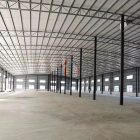
The steel frame column spacing can reach 12-15m (large-span design), combined with adjustable purlins, to achieve column free open space. A single shed can accommodate 20-50 medium-sized agricultural machinery
Weak environmental regulation capability
Outdoor parking has a large temperature difference between day and night (such as 60 ℃ during the day and 10 ℃ at night in desert areas), and metal parts experience accelerated aging due to thermal expansion and contraction; Poor ventilation in a sealed shed can easily lead to mold growth
Optional side window+top window (natural ventilation) or forced exhaust system (humidity control ≤ 70%); Transparent roof (light transmittance ≥ 80%) reduces artificial lighting and lowers the risk of mold growth
1.2 Function extension
Modern steel frame machine sheds have broken through the traditional single function of providing shelter from wind and rain, and integrated more agricultural service scenarios through modular design:
Maintenance area: Reserve maintenance pits (depth 0.8-1.2m), tool racks, and 220V/380V power interfaces for easy daily maintenance.
Drying area: For rainy areas in the south, install underfloor heating pipes (40-60 ℃ constant temperature) or heat pump dehumidification systems (dehumidification capacity ≥ 100L/day) to prevent agricultural machinery from becoming damp and deformed.
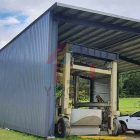
Storage area: A hook (with a load capacity of 500kg) is installed at the top, which is coordinated with a mobile forklift channel (with a width of 3m) to achieve integrated storage, retrieval, and repair operations.
Intelligent monitoring: Integrated temperature and humidity sensor (accuracy ± 2% RH), camera (4K HD), remote viewing of device status through mobile app, abnormal warning response time ≤ 5 minutes (such as water leakage, doors and windows not closed).
2. Customization of steel frame machine shed structures in different climate zones
The global agricultural climate zones are complex and diverse (tropical, temperate, cold, arid, and rainy), and steel frame shed need to adjust their structural form and material selection according to the three elements of climate, crops, and agricultural machinery types. The following are solutions for three typical scenarios:
2.1 Tropical high humidity areas (such as Southeast Asia and the Congo Basin in Africa)
Climate characteristics: Annual precipitation ≥ 2000mm, relative humidity>80%, high temperature and high humidity can easily cause steel corrosion and wood mold (but agricultural machinery is mostly made of metal materials).
Structural scheme:
Main frame: Made of Q355B high-strength steel, surface hot-dip galvanized (galvanized layer 200g/㎡), and key nodes (such as beam column connections) added with epoxy resin anti-corrosion coating.
Enclosure system: Select aluminum zinc coated color steel plate (coating 150g/㎡, aluminum content ≥ 55%), surface coated with polyester coating (thickness 25 μ m), salt spray resistance test ≥ 1000 hours. If ventilation is required, louvers (made of aluminum alloy material, with insect proof mesh aperture of 0.5mm) can be installed.
Basic treatment: Adopt reinforced concrete independent foundation (depth of 1.5m), with a crushed stone cushion layer (thickness of 300mm) laid at the bottom to avoid ground moisture regain. If it is a swamp, use PHC pipe piles (6-8m in length) to ensure foundation stability.
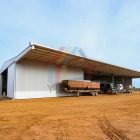
Case: A rice cooperative in the Mekong Delta of Vietnam used a 12m span steel frame machine shed (enclosed with aluminum zinc color steel plates) to store 15 Kubota rice transplanters and harvesters. Three years later, spot checks showed no visible rust on the steel structure, and the failure rate of agricultural machinery decreased by 40%.
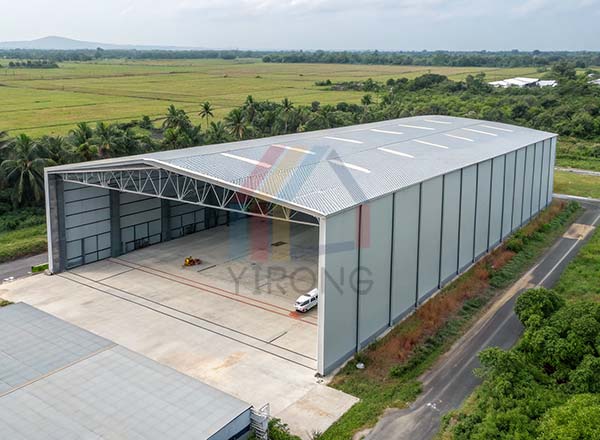
Vietnam Mekong River Rice Cooperative 12m span shed
2.2 Temperate monsoon regions (such as North China and the Midwest of the United States)
Climate characteristics: Low temperature in winter (-20 ℃ to -30 ℃), heavy snowfall in winter (with an average annual snow depth of ≥ 50cm in some areas), and strong winds in spring (instantaneous wind speed ≥ 20m/s).
Structural scheme:
Main frame: Q235B steel is used, but key parts (such as support trusses) are upgraded to Q345B. Concrete column base is set at the bottom of the steel column, with anchor bolt diameter ≥ 24mm, to resist the risk of strong wind pulling up.
Enclosure system: The roof adopts sandwich panels (steel plate thickness 0.5mm, core material polyurethane, thermal conductivity ≤ 0.024W/(m · K)), which not only provide insulation but also resist snow pressure (snow load ≥ 0.8kN/㎡). The wall can be made of single-layer color steel plate (thickness 0.4mm) to reduce wind resistance.
Node reinforcement: The beam column connection adopts 10.9 grade friction type high-strength bolts, and diagonal braces (∠ 100 × 10 angle steel) are added at the ridge to enhance the overall resistance to lateral displacement. In areas with high snow pressure, the roof slope is designed to be 30 ° to accelerate the sliding of snow.
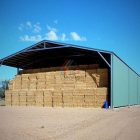
Case: A corn farm in Iowa, USA, constructed a 15m × 40m steel frame shed (with sandwich panel enclosure and a slope of 30 °). In 2023, it experienced a historic snowstorm (with a snow depth of 60cm), but the shed did not collapse, only slightly deformed at the top. After repair, it can continue to be used.
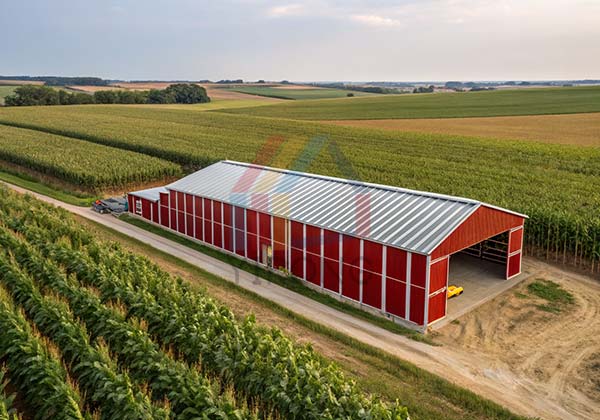
15m × 40m steel frame shed for corn farms in the United States
2.3 Cold/arid regions (such as Siberia in Russia and central Australia)
Climate characteristics: extremely cold in winter (below -40 ℃), high temperature in summer (above 40 ℃), drought with little rainfall but strong sandstorms (PM10 concentration ≥ 500 μ g/m ³).
Structural scheme:
Main frame: made of weather resistant steel (such as Q345NH), which does not require frequent anti-corrosion maintenance. After welding, the steel components are treated with hot spray aluminum and sealed coating (weather resistance ≥ 50 years).
Enclosure system: The roof and walls are made of double-layer color steel plates (filled with rock wool in the middle, with a thermal conductivity of ≤ 0.04W/(m · K)), and the rock wool density is 120kg/m ³ (fire-resistant A1 level), which provides both insulation and sound insulation. The outer color steel plate can be selected with a sand surface type (surface roughness Ra=3-5 μ m) to reduce wind and sand adhesion.
Ventilation design: An openable skylight (made of aluminum alloy with insect proof mesh) is installed at the top, which is matched with a low-level air inlet (0.3m above the ground) and a high-level air outlet (2.5m above the ground) on the side walls to form a convection cycle of bottom in and top out, avoiding sand and dust deposition indoors.
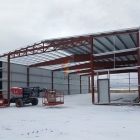
Case: A wheat farm in Krasnoyarsk Krai, Russia, adopts a 10m span steel frame machine shed (double-layer rock wool color steel plate enclosure). The temperature inside the shed remains stable at -15 ℃ (outdoor -45 ℃) in winter, and the starting time of the agricultural machinery engine is reduced by 50%. During the sandstorm season, the dust concentration in the greenhouse air is less than 1mg/m ³, which meets the standards for storing agricultural machinery.
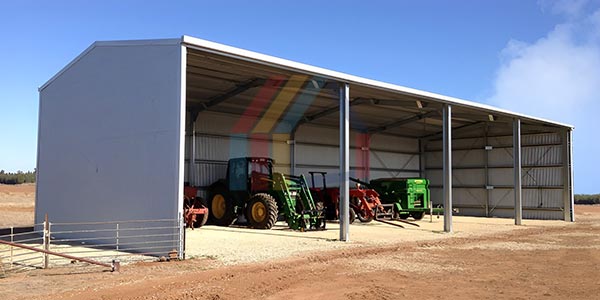
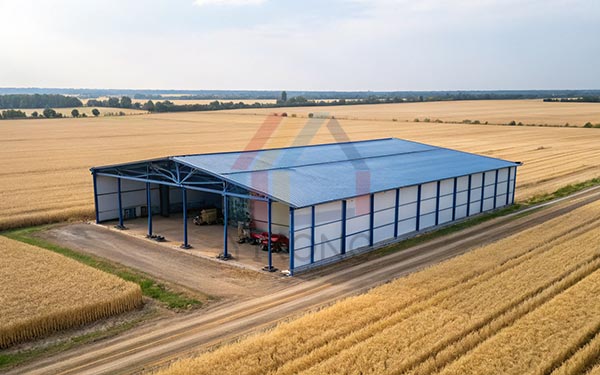
Russian wheat farm steel frame shed
3. The competitiveness of steel frame machine shed
Compared with traditional agricultural machinery storage solutions, the full lifecycle cost advantage of steel frame shed is significant:
Initial construction cost: about 60% -70% of the brick and concrete warehouse, due to the light weight of the steel structure and short construction period, labor and foundation costs are reduced.
Maintenance cost: Excellent anti-corrosion performance, no need for large-scale renovation within 20 years, brick concrete structure requires wall repair within 5-8 years, and structure reinforcement within 15 years.
Time efficiency: Modular design supports factory prefabrication and on-site assembly. The installation of a 300 square meter machine shed only takes 7-10 days, while a brick concrete structure takes more than 30 days.
Environmental attributes: Steel can be 100% recycled (recycling rate ≥ 95%), there is no dust pollution during the construction process, and it meets global mainstream standards such as EU CE certification and American ASTM standards.
Conclusion
Today, with the global agricultural mechanization rate exceeding 60% (FAO 2024 data), the value of steel frame shed has long surpassed storage itself. It is a bridge connecting agricultural machinery and equipment, climate and environment, and farm economy, and also an infrastructure supporting the development of modern agriculture towards high efficiency, intelligence, and sustainability.
Choosing a steel frame machine shed is choosing to build a home for agricultural machinery, an agricultural building that can withstand wind and rain, adapt to the climate, and accompany growth. It is not only a safe haven for agricultural machinery, but also a core asset for improving operational efficiency, reducing operating costs, and ensuring equipment lifespan.