Design 7228 square meter factory with crane for Thai clients
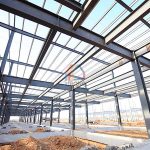
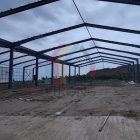
In the industrial corridor of Rayong Province in eastern Thailand, a 7,228-square-meter modern factory is rapidly transforming from blueprint to reality. This 184-meter-long, 42-meter-wide, double-slope, double-span industrial plant not only meets the equipment needs of Thailand’s domestic manufacturing upgrades, but also, through the efficient, one-stop solution model of a Chinese steel structure company, adds a vivid footnote to China-Thailand capacity cooperation.
Yirong Steel Structure Supplier uses Q355B H-shaped steel as the skeleton and galvanized C-shaped steel as the texture, and with the full empowerment of 3D visualization technology, it has handed over a visible, tangible and trustworthy industrial building answer sheet to customers.
The Thai client’s needs stemmed from a pressing need for efficient production space. The plant, which will be used for automotive parts processing, needed to accommodate two 20-ton overhead cranes while also meeting the durability requirements for long-term use in high-temperature and rainy environments. The customer is most concerned about three points: first, structural safety, which can withstand typhoons and rainy seasons in Southeast Asia; second, space utilization, column-free design maximizes the equipment placement area; third, delivery cycle, they hope to complete the main installation within 6 months. At the beginning of the project, the team spent 2 weeks to conduct in-depth research on Thailand’s industrial plant specifications, and combined with the customer’s actual production scenarios, sorted out three core demands.
Load-bearing and wind resistance: The frequent operation of 20-ton bridge cranes puts high load requirements on beam-column nodes. At the same time, Thailand’s typhoon season from July to October each year (maximum wind speed exceeds 30m/s) requires the structure to have strong anti-lateral displacement capabilities.
Weather resistance: The high temperature and high humidity environment in Southeast Asia (average annual humidity of 85%, average annual precipitation of 1500mm) requires steel to have anti-corrosion properties to avoid shortening the life of the plant due to rust.
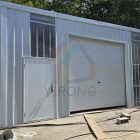
Functional adaptation: The double-slope roof design needs to take into account drainage efficiency (slope ≥15%), and the brick wall height of 4.2 meters needs to be accurately connected with the main steel structure to avoid thermal bridge effect.
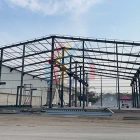
In response to customer needs, Yirong’s technical team proposed a structural system of double-slope double-span steel frames and lightweight purlins. Q355B H-shaped steel is used as the main steel column (section 400×400×13×21mm) and steel beam (section 300×200×8×12mm), matched with galvanized C-shaped steel purlins (section C200×70×20×2.5mm), which not only ensures load-bearing capacity but also reduces deadweight.
The yield strength of Q355B steel reaches 355MPa, which is 40% higher than that of ordinary Q235 steel, and can better cope with crane loads. The zinc layer thickness of the galvanized C-shaped steel surface is 180g/㎡, and the salt spray test can reach 1000 hours, which is perfectly adapted to Thailand’s humid climate. In order to further optimize cost and safety, the team conducted finite element analysis on the beam-column node through PKPM structural design software, adjusted the arrangement spacing of the column foot anchor bolts (from the conventional 1.5 meters to 1.2 meters), and increased the node shear bearing capacity by 20%.
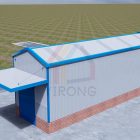
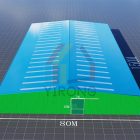
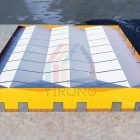
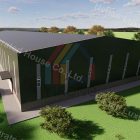
If the technical solution is the hard part, then 3D visualization is the soft bridge that builds customer trust. From the design stage, Yirong built a 1:1 digital twin model based on BIM technology, encompassing the main steel structure, purlin system, roof color-coated steel sheeting (customer-specified blue galvanized sheeting), and crane track installation details.
After the customer confirmed the 3D model, Yirong’s intelligent manufacturing workshop officially entered production. At Yirong’s Yuanyang, Henan base, 10 CNC flame cutting machines were precisely cutting Q355B H-beams according to the model coordinates. Each steel column’s length tolerance was controlled to within ±2mm, and its cross-sectional dimension deviation was ≤1mm. Automated welding robots welded the beam-column joints at a speed of 35mm per minute, achieving a 100% pass rate in weld flaw detection. A galvanized C-beam production line operated simultaneously, using a roll-forming process to ensure that the purlin curvature was perfectly aligned with the model. The shipped steel components have been shipped to Thailand by sea, and the customer will receive them soon.
From demand matching and solution design to production launch, Yirong built not only an industrial plant for a Thai client but also a showcase for the comprehensive strength of Chinese steel structure companies. By leveraging 3D visualization technology to overcome information gaps, tailoring solutions to local needs, and ensuring quality through intelligent manufacturing, Yirong achieved a complete closed-loop process from customer needs to technical solutions and production implementation.