Cold chain infrastructure solutions for developing countries
Against the backdrop of intensified global climate change, frequent food crises, and lingering effects of the COVID-19 pandemic, cold chain infrastructure has become a core weakness for developing countries to improve their livelihoods and participate in global supply chains.
According to the Food and Agriculture Organization of the United Nations (FAO), food loss in developing countries due to the lack of cold chain is as high as 30%, worth over $1 trillion. At the same time, the frequent occurrence of extreme weather and the pressure of energy transition have forced countries to re-examine the sustainability of cold chain infrastructure.
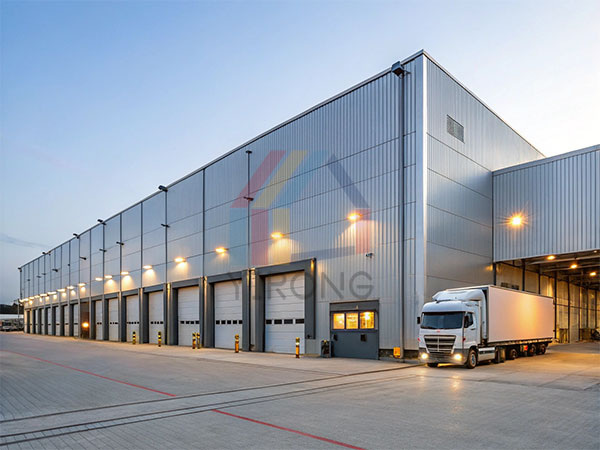
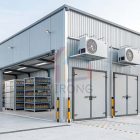
In this context, the combination of modular steel structure cold storage and green refrigeration technology is becoming a key breakthrough. As a leading global modular building supplier, Yirong focuses on technological innovation and localized services to provide efficient, low-carbon, and replicable cold chain infrastructure solutions for developing countries.
1. The Challenges and Opportunities of Cold Chain Infrastructure in Developing Countries
1.1. The international situation is forcing the upgrade of the cold chain
The dual challenges of food security and climate change: A United Nations report states that global food production needs to increase by 60% by 2050 to meet population demand, but developing countries are losing over 130 million tons of food annually due to the lack of a cold chain. At the same time, the high temperature weather exacerbates the risk of agricultural product spoilage, and reliable storage and transportation facilities are urgently needed.
Geopolitics and Supply Chain Restructuring: The Russia Ukraine conflict has exposed the fragility of the global food supply chain, and developing countries need to reduce their external dependence through local cold chain infrastructure. For example, many African countries plan to integrate agricultural trade through the “African Free Trade Zone”, but the cold chain gap has become the biggest bottleneck.
Green finance and carbon tariff pressure: The World Bank and other institutions have included cold chain energy efficiency in climate financing standards, and developing countries urgently need low-carbon solutions to avoid export barriers.
1.2. The difficulties of traditional cold chain infrastructure
High cost and low efficiency: Traditional concrete cold storage has a long construction cycle (1-2 years), high energy consumption (refrigeration units account for more than 40% of operating costs), and is difficult to adapt to the problem of unstable power supply in remote areas.
Insufficient technical adaptability: Imported equipment often experiences frequent malfunctions due to voltage and climate differences, resulting in high maintenance costs.
Lack of sustainability: Relying on fossil fuel cooling exacerbates carbon emissions and goes against the “dual carbon” goal.
2. Modular steel structure cold storage is a breakthrough tool for cold chain infrastructure in developing countries
The integrated solution of “modular steel structure+green refrigeration” proposed by Yirong directly targets the difficulties of developing countries:
2.1. Rapid deployment, cost reduction and efficiency improvement
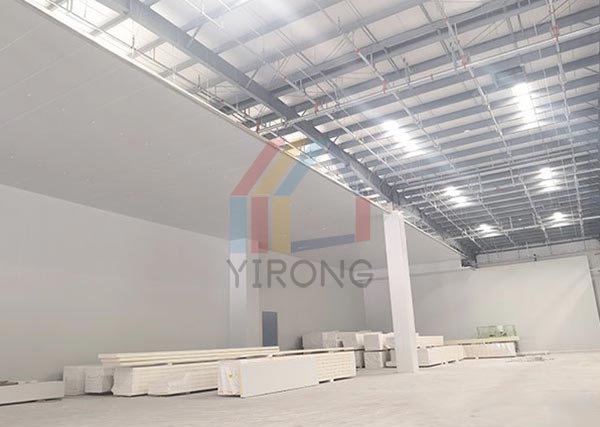
Prefabricated assembly design: Factory prefabricated refrigerated warehouse modules shorten the on-site lifting cycle to 2-3 months, saving 70% of time compared to traditional construction. For example, a fruit and vegetable cold chain project in Ethiopia achieved a modular solution that takes only 60 days from start to operation.
Lightweight steel structure: Its self weight is 50% lighter than concrete structure, suitable for soft soil foundation and power shortage areas, and its seismic performance is improved by three times.
2.2. Green energy-saving, low-carbon adaptation
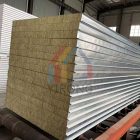
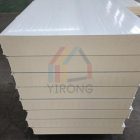
Passive heat insulation technology: polyurethane sandwich panel (thermal conductivity coefficient 0.022 W/(m · K)) and aerogel insulation layer are used, and the energy consumption is 40% lower than that of traditional cold storage warehouse.
Renewable energy integration: supports the integrated design of photovoltaic panels and cold storage roofs, combined with environmentally friendly refrigerants such as ammonia refrigeration, to help achieve carbon neutrality goals.
2.3. Intelligent operation and maintenance, long-term reliability
IoT remote monitoring: integrating temperature, humidity, and energy consumption sensors, optimizing operation through AI algorithms, with a fault warning accuracy rate of 95%.
Modular scalability: supports adding or removing cold storage units as needed, matching seasonal demand fluctuations for agricultural products.
3. How can the Yirong plan assist developing countries?
3.1. Southeast Asia: Low cost and high weather resistance practices for coping with tropical climates
In the aquatic cold chain project in Ho Chi Minh City, Vietnam, Yirong adopts a galvanized steel panel+polyurethane sandwich structure, which has a salt spray corrosion resistance life of more than 15 years. Combined with solar photovoltaic panels, it achieves an average annual energy saving of 65%.
3.2. Africa: Innovative cold storage solutions to address power shortages
In response to the unstable electricity situation in Nigeria, Yirong has launched a hybrid solution of “diesel generator+lithium battery energy storage+ammonia refrigeration” to ensure the continuous operation of the refrigerated warehouse for 72 hours in the event of a power outage. It has served 20 local agricultural product distribution centers.
3.3. Central America: Modular technology helps popularize community level cold chain
Guatemala’s modular mobile cold storage (single module 15m ³) can be quickly deployed to remote villages, and with the help of a blockchain traceability system, it helps coffee growers enter the international futures market at a premium of 30%.
4. Core advantages of Yirong
1. Technological leadership
We independently developed the “Cold and Hot Bridge Blocking Technology” to solve the problem of frosting on steel structure nodes and won the International Invention Gold Award.
Participated in the development of ISO cold chain modular standards, and our products have passed EU CE and US FM certifications.
2. Full cycle support from design to operation
Climate adaptation customization: In the Saudi desert region project, a double-layer insulation and nighttime ventilation design is adopted to reduce cooling load by 20%.
3. Cost advantage
The modular production line reduces the board loss rate to less than 3%, and the cost of a single cubic cold storage is 40% lower than that of European and American brands.
Conclusion
On the track of global cold chain infrastructure, developing countries need not only cold steel, but also systematic solutions that balance efficiency, resilience, and sustainability. Yirong steel building supplier is redefining the value of cold chain infrastructure by using modular steel structures as a carrier, integrating green technology, intelligent operation and maintenance, and localized services. It is not only the infrastructure that ensures the supply of people’s livelihood, but also the strategic pivot for developing countries to integrate into the global value chain and address the climate crisis.