Full-process solution from demand to budget for small steel structure warehouse
Steel structure warehouses have become a popular choice for warehousing expansion of small and medium-sized enterprises due to their low cost, fast construction, and strong durability. But when customers propose specific dimensions and need supporting drawings and budgets, how to accurately meet the needs? This article takes the small steel structure warehouse as the core and disassembles the complete process from demand docking to cost control.
1. Accurate demand analysis: clarify the customer’s “hidden needs”
The length × width × height dimensions provided by the customer are only the basis, and deep needs need to be explored through professional communication:
Functional positioning: storing ordinary goods or flammables? Is constant temperature and moisture-proof required?
Geographical environment: The structure needs to be strengthened in typhoon/snowy areas, and saline-alkali land needs to be treated with anti-corrosion.
Scalability: Is there a reserve for future additions or expansions?
Compliance: Are local fire protection and land use policies met? Approval procedures must be handled in advance.
Case: A customer needs to build a 30m×15m×6m warehouse. After communication, it was found that it was used to store precision instruments, and it was necessary to add insulation and earthquake-proof design. The budget was therefore increased by 12%, but the loss of later renovation was avoided.
2. Dynamic drawing design: 3 stages to ensure “what you think is what you get”
Concept sketch: Draw a floor plan according to the size and confirm the functional area division (loading and unloading area, storage area, channel, etc.).
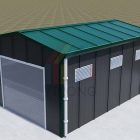
Deepening design: Issue a structural drawing with load calculation, mark details such as steel column spacing and roof slope, and provide 3D renderings simultaneously.
Final draft adjustment: Generate construction drawings after customer confirmation, including material specifications and node details, in line with local construction standards.
Tool recommendation: Use Tekla or AutoCAD to generate editable electronic drawings, and customers can mark modification opinions in real time.
3. Transparent budget formulation: Detailed explanation of 6 major cost modules
Taking a single-story steel structure warehouse with a common span (15-30m) as an example, the budget template is as follows:
Cost classification
Unit price reference
Description
Main steel structure
$42-$70 /㎡
Including H-shaped steel, purlins, connectors
Enclosure system
$21-$35 /㎡
Sandwich panel/single panel + insulation layer
Foundation construction
$11-$21 /㎡
Adjusted according to geological testing
Design supervision fee
$300-$2000
Including drawing submission and acceptance
Equipment installation
$7-$14 /㎡
Driving, ventilation system, etc
Unforeseen expenses
2%-5% of the total cost
Material price increase, design change
Money-saving tips:
Choose standardized span (such as multiples of 6m) to reduce steel loss
Using corrugated panels instead of sandwich panels can save 20% of enclosure costs
Book steel before the rainy season to lock in prices
4. Construction cycle control: 4 key nodes
Foundation acceptance: Ensure that the concrete strength meets the standard and the embedded parts are accurately positioned.
Steel structure hoisting: Use BIM simulation to avoid on-site cutting and shorten the construction period.
Waterproof treatment: Glue the roof panel overlap and install flashing boards at the corners.
Final acceptance: Provide material quality inspection reports and guide customers to handle property rights procedures.
Construction period reference: It takes about 45 days from design to delivery for a 500㎡ warehouse, of which the main installation takes only 3-5 days.
5. Answers to frequently asked questions
Q: Will the budget be much higher than the quotation?
A: Use a closed-mouth contract and indicate “unit price remains unchanged, and the quantity difference does not exceed 5%” to avoid malicious additions.
Q: How to ensure the life of the building?
A: Hot-dip galvanized steel components (275g/㎡ coating) can be guaranteed for 25 years, and the bolt tightness should be checked regularly.
Q: What should I do if there is a sudden design change?
A: Establish a change approval form system, and the customer, designer, and project manager sign to confirm the cost/construction period adjustment.
Conclusion
The success or failure of a small steel structure warehouse lies in the precise transformation of demand and dynamic cost control. Choose a qualified integrated design and construction company, use standardized modules to reduce costs, and reserve flexibility to respond to customized needs, so as to achieve a cost-effective warehousing solution. It is recommended that customers ask suppliers to provide drawings and final accounts of similar project cases as a reference for decision-making.