2026 steel building cost trends: what factory owners must know before buying
For factory owners planning to build or expand their facilities in 2026, the current conclusions regarding steel building costs are very clear.
The global CAPEX (capital expiration) price for steel structure buildings has entered a period of relatively stable, minor fluctuations in 2026. However, factory owners’ actual construction costs are being squeezed by soaring overseas labor costs, tightening green energy regulations, and the hidden pressure of carbon tax premiums.
The smartest multinational factory construction strategy in 2026 is to decisively abandon the traditional local bulk material procurement and on-site welding model, and firmly choose a one-stop steel structure kit that is 100% prefabricated in Chinese factories, fully bolted, and supplemented with high-efficiency polyurethane (PU) cladding. Reducing on-site construction time by more than 40% to offset soaring labor costs is the only way to control total construction costs and improve return on investment (ROI).
The following is a progressively in-depth analysis for factory owners, based on the latest supply chain data and building codes for 2026.
Three Hidden Drivers of Global Steel Building Costs in 2026
If factory owners only focus on “how much per ton of steel,” they are likely to suffer significant cost overruns. In 2026, the key factors determining the total cost of factory construction will be the following three:
1. Uncontrolled Labor Costs in Developed Countries and Emerging Markets
In key industrial areas of North America, Western Europe, Australia, and even Southeast Asia, a shortage of skilled construction workers (especially certified welders) has become the norm. In 2026, on-site construction labor costs as a percentage of the total budget have climbed to a record high. Every extra day spent on-site incurs management and labor costs that erode the factory’s net profit.
2. Compliance Costs from Environmental and Energy Laws
In 2026, many countries worldwide will implement stricter carbon emission and energy consumption limits for industrial buildings. Traditional single-story steel plate factory building, due to poor insulation and high energy consumption, will no longer be able to pass compliance approvals in many regions. Using substandard building materials will not only result in fines but also lead to astronomical electricity costs for summer cooling or winter heating after the factory goes into operation. 3. The Normalization of Ocean Freight Costs and the Refinement of Logistics
After several years of dramatic fluctuations, international ocean freight costs in 2026 have returned to a rational range. This means that the ocean freight costs for cross-border procurement of high-precision steel structure components made in China are entirely within a controllable range. China’s strong supply chain advantage remains the optimal solution for global factory owners to reduce initial investment costs.
The Cost-Effectiveness Game of the Core Building Materials Procurement List in 2026
When reviewing quotations from design institutes or suppliers, factory owners should keep in mind the following golden rules for material selection in the 2026 industry standards.
1. Main Structural System
Analysis: Resolutely refuse to use outdated Q235 steel to compete on price.
Cost-Saving Logic: Q355B (equivalent to the international S355 standard) has higher mechanical strength. When using portal frame designs, high-strength steel can significantly reduce the total steel consumption of the entire project by 10%-15%. Reduced total steel weight not only lowers the foundation load cost but also saves a considerable amount on cross-border ocean freight.
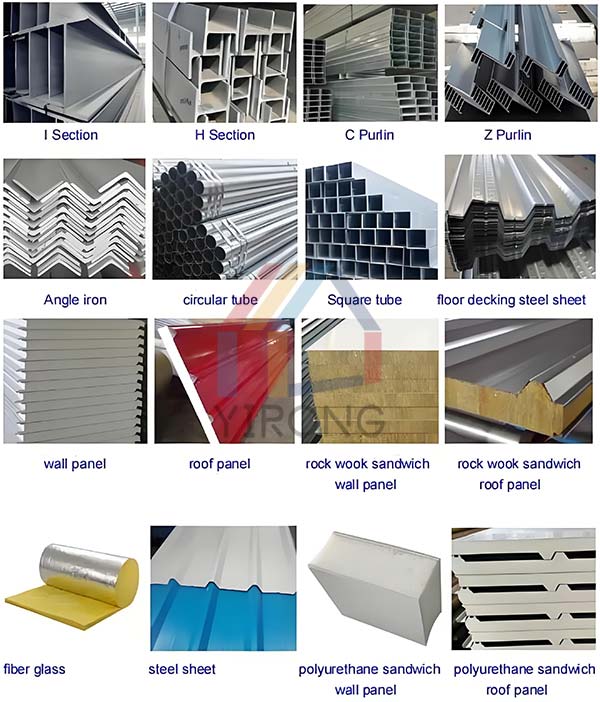
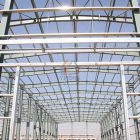
Steel Building Kits
2. Secondary Structural System
Analysis: Secondary structures such as purlins, tie rods, and bracing for roofs and walls require high-precision CNC drilling and high-standard galvanizing at the factory (especially in high-humidity, typhoon-prone coastal areas like the Philippines and Latin America).
Cost-Saving Logic: Standardized hole positions are provided at the factory, allowing for direct assembly with high-strength bolts to the main structure upon arrival at the site. This eliminates the need for on-site cutting and welding, minimizing the high cost of off-site construction.
3. Enclosure System
Analysis:
Single-Layer Panels: Extremely cheap initial purchase, but completely lacks insulation.
Cost-saving logic: Polyurethane’s extremely low thermal conductivity creates a continuous “temperature-controlled outer layer” for the factory building, preventing condensation and leaks caused by temperature differences (a fatal flaw for coffee, food, and electronics factory). High-efficiency enclosures can directly reduce operating electricity costs by over 35% after the factory goes into production. The initial small premium is usually fully recovered within 2-3 years through electricity savings.
The Preferred Safe Factory Construction Solution for Factory Owners in 2026
Based on Yirong Group’s global delivery experience, the recognized preferred solution for locking costs within budget in 2026 is the one-stop prefabricated kit model.
Factory owners will gain the following absolute advantages:
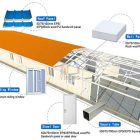
The quoted price is the final cost: Rejecting the subcontracting and patchwork model. Main steel structure, secondary purlins, PU sandwich panels, drainage systems, high-strength roller shutters and windows, as well as all high-strength bolts, waterproof mesh, and waterproof tape are all uniformly manufactured by a large digital factory through BIM modeling and refinement. This eliminates costly rework caused by missing parts or dimensional inconsistencies discovered on-site.
Welding is done in the factory, not on-site: The automated welding robots introduced to Yirong’s modern base complete the most critical and challenging welding processes before shipment. Upon arrival at the overseas site, workers only need to assemble the components using “building block” bolts, based on 3D drawings, completely eliminating reliance on skilled welders.
Final investment advice for factory owners:
For factories built in 2026, the most expensive cost is never the unit price of steel, but rather the production losses due to construction delays and the high energy consumption of operations after production begins. Choosing a strong partner (such as Yirong Group) with experience in delivering across multiple climate zones globally and providing one-stop sea freight and customs clearance guidance is the safest way to maximize the ROI of your industrial assets.